Systems Research

PhD success for a former graduate
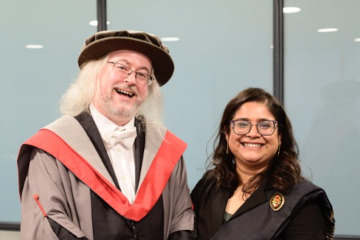
Simon and Indushree, PhD graduation 2022

Last month Professor Simon Dobson was invited to be on the PhD examining committee for Indushree Banerjee at TU Delft. She passed with flying colours, for her thesis on ad hoc network protocols for use in disaster recovery situations. The protocol is designed around a very strong model of social justice and equality, working on PhD success for a former graduate

Systems Research Group seminars

The Systems Research Group is re-starting their seminars series from 6th May 2022. Seminars will take place every two weeks at 1pm, on Fridays. From May to July the seminars will be online (SRG Teams), while from September onward we aim to move them to a hybrid format. More information on the schedule can be Systems Research Group seminars

Donald Robertson awarded Brendan Murphy Prize at MSN/Cosener’s 2019!

Each year in July, the (broadly-defined) computer networking community converges at Cosener’s House for the MSN workshop. The workshop is an informal gathering where attendees – students in particular – are encouraged to present on-going work and/or crazy ideas. From among the  presentations, the Brendan Murphy Award is given to the best student presentation, generally Donald Robertson awarded Brendan Murphy Prize at MSN/Cosener’s 2019!

SRG Seminar: “Large-Scale Hierarchical k-means for Heterogeneous Many-Core Supercomputers” by Teng Yu

We present a novel design and implementation of k-means clustering algorithm targeting supercomputers with heterogeneous many-core processors. This work introduces a multi-level parallel partition approach that not only partitions by dataflow and centroid, but also by dimension. Our multi-level ($nkd$) approach unlocks the potential of the hierarchical parallelism in the SW26010 heterogeneous many-core processor and the SRG Seminar: “Large-Scale Hierarchical k-means for Heterogeneous Many-Core Supercomputers” by Teng Yu

SRG Seminar: “Using Metric Space Indexing for Complete and Efficient Record Linkage” by Özgür Akgün

Record linkage is the process of identifying records that refer to the same real-world entities, in situations where entity identifiers are unavailable. Records are linked on the basis of similarity between common attributes, with every pair being classified as a link or non-link depending on their degree of similarity. Record linkage is usually performed in SRG Seminar: “Using Metric Space Indexing for Complete and Efficient Record Linkage” by Özgür Akgün

SRG Seminar: “Efficient Cross-architecture Hardware Virtualisation” by Tom Spink

Virtualisation is a powerful tool used for the isolation, partitioning, and sharing of physical computing resources. Employed heavily in data centres, becoming increasingly popular in industrial settings, and used by home-users for running alternative operating systems, hardware virtualisation has seen a lot of attention from hardware and software developers over the last ten?fifteen years. From SRG Seminar: “Efficient Cross-architecture Hardware Virtualisation” by Tom Spink

Dasip 2018 Keynote: Professor Simon Dobson

Head of School Simon Dobson will deliver a keynote at Dasip, the Conference on Design and Architectures for Signal and Image Processing in October in Porto. Dasip provides an international forum for innovation and developments in the field of embedded signal processing systems. Simon’s keynote will focus on making the transition from sensors to sensor Dasip 2018 Keynote: Professor Simon Dobson

An Academic’s Observations from a Sabbatical at Google

Professor Adam Barker is featured in this month’s Communications of the ACM Magazine (CACM) discussing his recent Visiting Faculty appointment at Google. The Viewpoints article summarises his experiences working in software engineering on the Borgmaster team, and some of the core lessons which can be brought back to academia. Borg is Google’s cluster management framework, An Academic’s Observations from a Sabbatical at Google

SRG Seminar: “Application of Bayesian Nonparametric in household human activity recognition” by Lei Fang

Abstract In this talk, I will talk about the possibility of using Bayesian nonparametric clustering, or Dirichlet Process Mixture model to solve human activity recognition problem. In particular, I will discuss how the technique can be useful when the activity labels are not annotated and/or the activity evolves over the time. This initial study is SRG Seminar: “Application of Bayesian Nonparametric in household human activity recognition” by Lei Fang

SRG Seminar: “Introduction to Apache Mesos and the DataCenter Operating System” by Matt Jarvis

Abstract Data processing paradigms are undergoing a paradigm shift as we move more and more towards real time processing. Emerging software models such as the SMACK stack are at the forefront of this change, focused on a pipeline processing model, but are also introducing new levels of operational complexity in running multiple complex distributed systems SRG Seminar: “Introduction to Apache Mesos and the DataCenter Operating System” by Matt Jarvis