

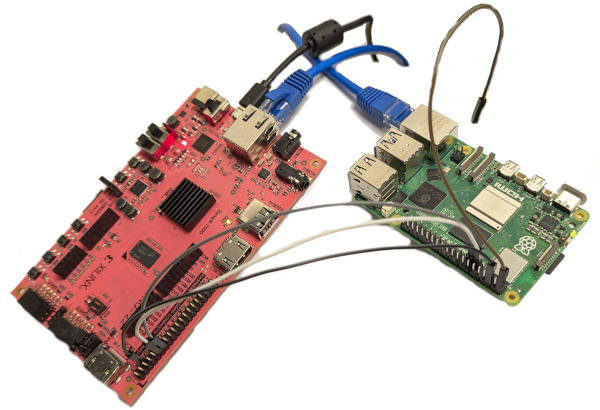
 As the Internet ofThings (IoT) expands, the number of connected devices is expected to reach close to 30 billion by 2030. These devices range from simple sensors to complex embedded systems, each with unique characteristics and communication protocols. Simulating such a vast and diverse array of devices presents a significant challenge in terms of scalability, accuracy, and efficiency. This PhD project aims to develop a comprehensive framework for simulating many (1000s, 10,000s, 1,000,000s) heterogeneous IoT devices, at (hopefully) close to real-time speeds. The project will focus on designing a specialised languages for describing hardware and simulations, creating an efficient simulation environment, and exploring hardware acceleration techniques to achieve high performance and scalability.
Previous research in this area has primarily focused on simulating individual devices, smaller networks, or using simplified models that do not fully capture the intricacies of real-world IoT systems. This project seeks to address these limitations by developing a scalable simulation framework that can accurately model the behaviour of billions of heterogeneous devices, advancing the state-of-the-art in simulation languages, distributed computing, and hardware acceleration.
The project will be structured around three core research ideas:
- Simulation Languages for Heterogeneous Embedded Devices: The first research objective is to explore the creation of a specialised language for describing the behaviour and interactions of heterogeneous IoT devices. This language will need to be expressive enough to capture the wide range of device architectures and communication protocols found in IoT systems. The language will also support modularity and extensibility, allowing users to easily incorporate new device types and behaviours into the simulation.
- Development of a Scalable Simulation Environment: The second research objective is to create a simulation environment that can efficiently emulate IoT devices at scale, across multiple simulation servers. This environment will be designed to support distributed computing, allowing for parallel execution of simulated devices across a large number of servers. The project will explore various techniques for load balancing, synchronisation, and communication between servers to ensure that the simulation remains efficient and accurate as the scale increases.
- Hardware Acceleration for Large-Scale Simulations: The third research objective is to investigate the use of hardware acceleration techniques, such as Field Programmable Gate Arrays (FPGAs) and Graphics Processing Units (GPUs), to improve the performance of large-scale IoT simulations. This aspect of the project will focus on identifying the components of the simulation that can be offloaded to specialised hardware, and developing algorithms and architectures that leverage this hardware to achieve significant performance gains.
Topics of Interest
- Heterogeneous Systems Modelling: Techniques for accurately modelling the diverse architectures and communication protocols of IoT devices.
- Distributed Simulation: Methods for efficiently distributing simulations across multiple servers, including load balancing, synchronisation, and inter-server communication.
- Simulation Languages: Design and implementation of specialised languages for describing complex IoT devices and networks.
- Hardware Acceleration: Exploration of FPGA, GPU, and other hardware acceleration technologies to enhance the performance of large-scale simulations.
- Scalability and Performance Optimisation: Strategies for ensuring that the simulation framework can handle the increasing complexity and scale of IoT networks.
- Validation and Verification: Techniques for validating and verifying the accuracy and reliability of large-scale IoT simulations.
The Scholarship
We have one fully-funded scholarship available, starting in September 2025, which will be awarded to competitively to the best applicant. The scholarship covers all tuition fees (irrespective of country of origin) and comes with a stipend valued at £19,705 per annum. More details can be found here: https://blogs.cs.st-andrews.ac.uk/csblog/2024/10/24/phd-studentships-available-for-2025-entry/
International applications are welcome. We especially encourage female applicants and underrepresented minorities to apply. The School of Computer Science was awarded the Athena SWAN Silver award for its sustained progression in advancing equality and representation, and we welcome applications from those suitably qualified from all genders, all races, ethnicities and nationalities, LGBT+, all or no religion, all social class backgrounds, and all family structures to apply for our postgraduate research programmes.
To Apply
Informal enquiries can be directed to Tom Spink. Full instructions for formal applications can be found at https://www.st-andrews.ac.uk/computer-science/prospective/pgr/how-to-apply/
The deadline for applications is 1 March 2025.