War Stories: Building new tech products in an uncertain world

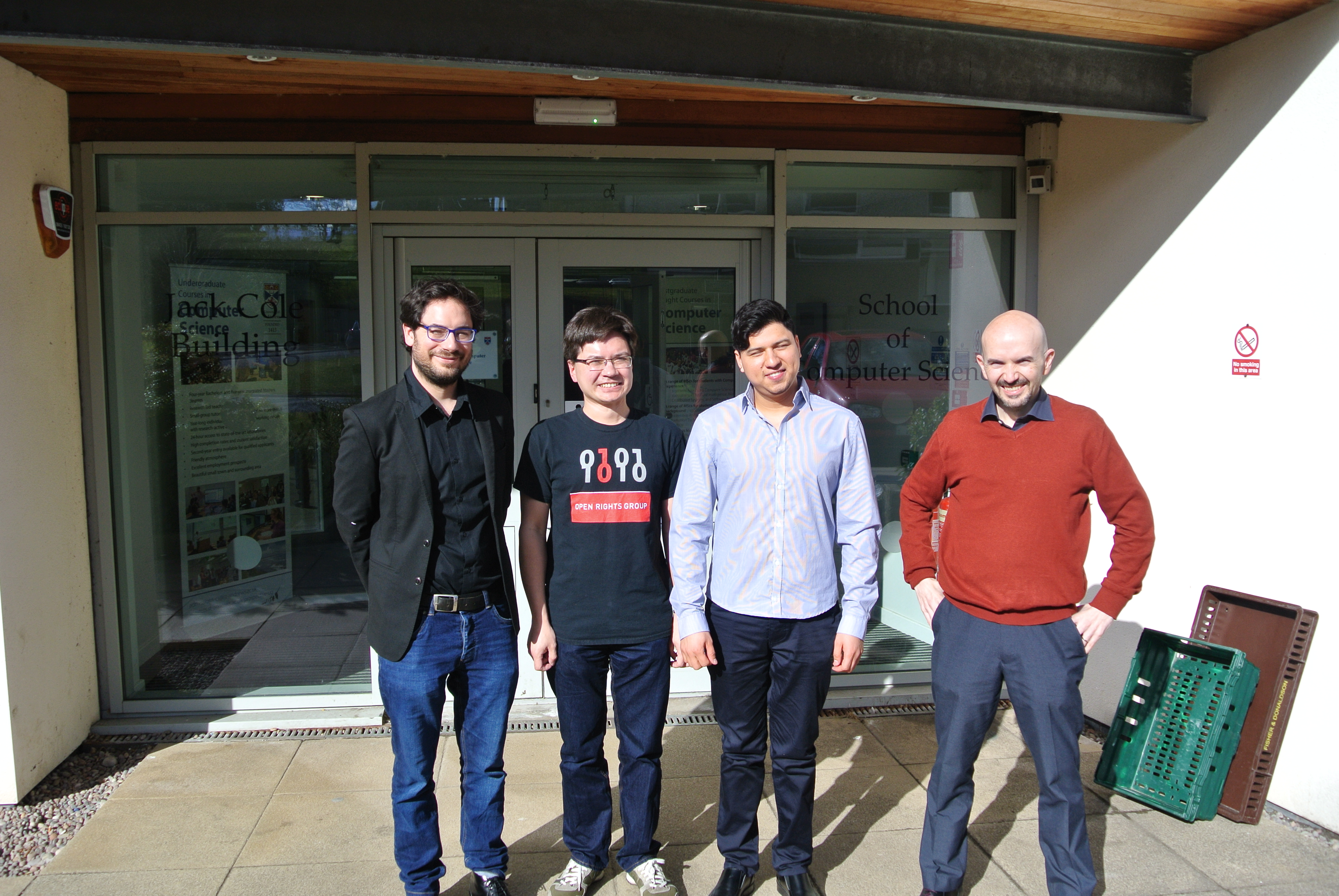
Steven Drost (CodeBase Chief Strategy Officer) and Jamie Coleman (CodeBase CoFounder and Chair) will talk about the topics that are rarely discussed in an academic environment around startups, product management, jobs to be done and disruption. Discussing aspects of UX, HCI, AI and systems development this is the stuff that they wish every computer scientist and startup founder knew before trying to create an innovative new business.

What is CodeBase?

CodeBase is the UK’s largest startup incubator, home to around 100 technology companies in Edinburgh and Stirling. It brings together ambitious entrepreneurs, world-class technological talent and top investors, in a creative, collaborative environment designed for the new digital economy. We host a vibrant, open community of experts in a diverse range of fields, with hands-on mentorship, networking and world-class business support. http://www.thisiscodebase.com

Jamie and Steven are quite inspiring speakers and if you are looking for project partners, collaborators or just to learn how to develop your ideas commercially, this could be a good talk for you.


Event details

  • Where: Cole 1.33a
  • Format: Seminar

Old French Bible Project

A project funded by the Undergraduate Research Assistant Scheme has successfully completed the first stage of interdisciplinary work, between the Institute of Mediaeval Studies and the School of Computer Science.  The long-term aim is to digitise and analyse early French bibles.

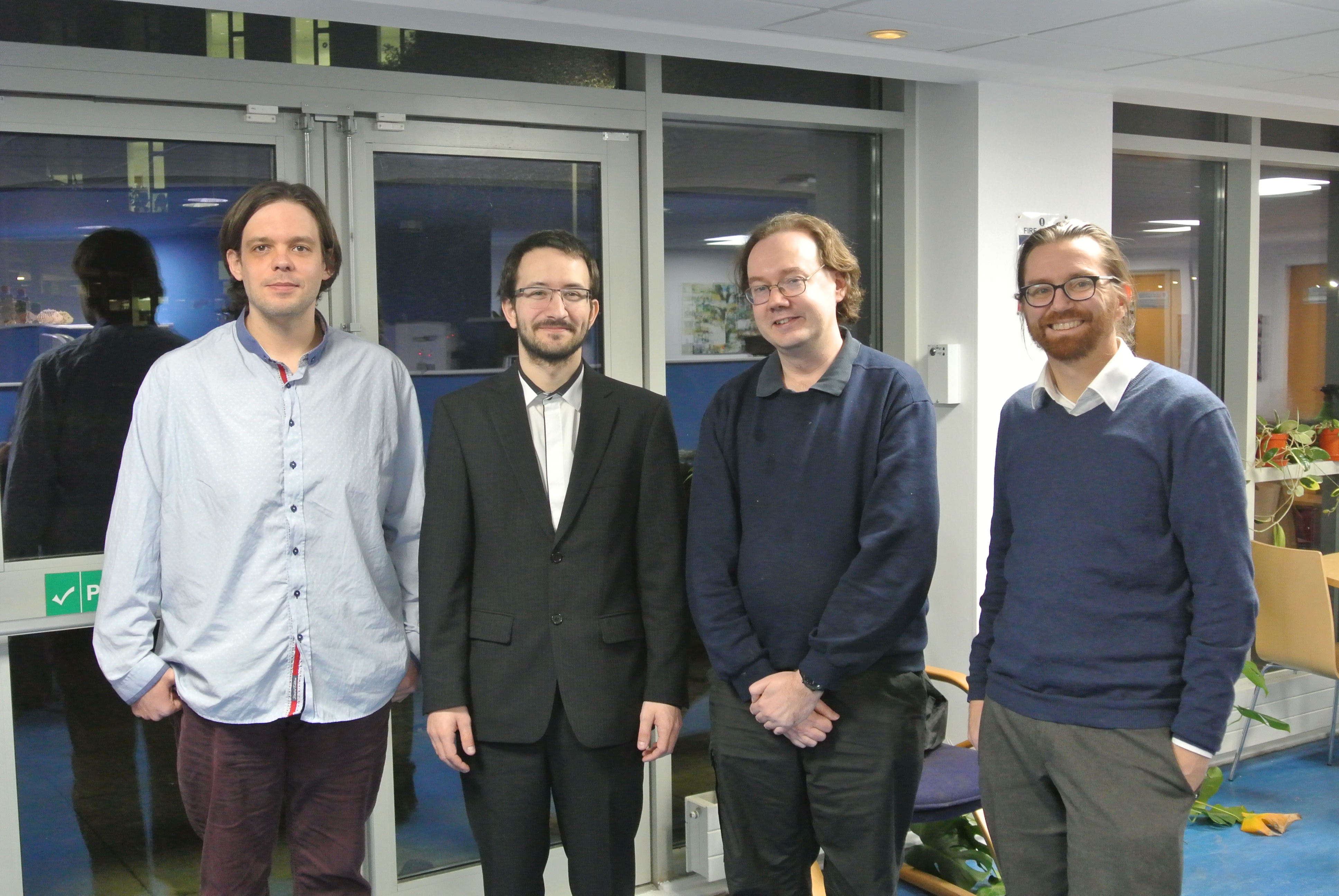
In this pilot project, undergraduate student Gregor Haywood, under the supervision of Prof. Clive Sneddon and Dr. Mark-Jan Nederhof, explored the feasibility of large-scale OCR technology for early printed text.  Scans from a French bible from 1543 were provided by the Special Collections of the University Library.  Much of the project consisted of iterations of automatic transcription, manual correction, retraining, and evaluation of accuracy.  In addition, problems were investigated that specifically arise from taking OCR technology designed for modern printed documents and applying it on early documents. Such problems include non-standard character sets, non-standard page layout, faded or smudged ink, and torn pages.

Despite of these problems, it was demonstrated that error rates below 3% are achievable, which paves the way for a continuation of these efforts.

Funding success for characterizing the adoption of ORCID ID in academic communities

Alex Voss from the School of Computer Science and Anna Clements and Eva Borger from the University Library have been awarded funding by OCLC for a 1-year project titled “Characterizing the adoption of ORCID ID in academic communities”.

ORCID iDs are persistent digital identifiers that distinguish researchers and, through integration in key research workflows such as manuscript and grant submission, support automated linkages between individuals and their professional activities ensuring that their work is recognized and attributed.

The funded project, which began in March, expands on a pilot study carried out in 2017 by Eva as part of her MSc dissertation project, which investigated the adoption and use of ORCID iDs among researchers at the University of St Andrews and identified key use cases and new avenues for advocacy.

The team now aim to carry out similar surveys at other institutions that integrate ORCID iDs and build a bigger picture of how advocacy, institutional processes and mandates relate to the adoption of ORCID iDs in academic communities. Based on these findings, they plan to formulate recommendations on how advocacy and policies regarding ORCID iDs can be employed to maximise their value in the research process.

Alex Voss has a related MSc dissertation, Consolidating Output and Citations Data, for students interested in this particular project or research area.

If you would like to find out more about ORCID iDs at the University of St Andrews, visit their ORCID pages. For more information about the project, please contact Alex Voss at alex.voss@st-andrews.ac.uk or visit the ORCID study blog for ongoing updates.

Scholarships and bursaries: student perspectives and experiences

Applying to study at university includes many financial considerations. Scholarships and bursaries can help reward academic achievement and provide financial awards enabling students to undertake or further their education. Students in Computer Science have secured a variety of bursaries to help fund their passion for the subject. Successful undergraduate and postgraduate student perspectives are highlighted below.

Sherlock Cruz , the first recipient of The London Scholarship reflected on his time at St Andrews and how scholarships can transform lives. The scholarship encourages young students from the Greater London area to study at St Andrews by equipping them with accommodation and living costs.

The School is fortunate in receiving on-going support from Adobe for undergraduate students studying Computer Science by way of Adobe Prize Bursaries. Successful applicants receive an award each year for the duration of their degree.

Henry Hargreaves was the successful recipient of a Royal Television Society Technology Bursary. The bursary encourages the most talented Engineering and Computer Sciences undergraduates to consider a career in television.

Royal Television Society Bursary: Henry Hargreaves

Alice Herbison secured a Carnegie-Cameron Bursary to support postgraduate study enabling her to undertake our MSc in Human Computer Interaction.

Carnegie-Cameron Taught Postgraduate Bursaries 2013

Arkwright Awards for budding young engineers nurtures high-potential A-level and Scottish Advanced Higher students who have a desire to be future leaders in engineering disciplines, including computing, software, communications and product design. More information on Arkwright engineering awards and who can apply can be located on their website.

Arkwright Awards for budding young engineers

The scholarships and funding catalogue has up-to-date information on eligibility for undergraduate and postgraduate applicants.

Marwan Fayed (St Andrews): Quality of Experience Fairness for Adaptive Video Streams in the Network (School Seminar)

Abstract:

“Why is my kid getting HD on their phone, while I’m stuck with SD on my 50″ TV?” This type of complaint is among the most common directed to streaming services such as Netflix and BBC. Recent studies observe that adaptive video streams, when competing behind a bottleneck link, generate flows that lead to instability, under-utilization, and unfairness. Additional measurements suggest there may also be a negative impact on users’ perceived quality of experience as a consequence. The intuitive response may be, and has been, that application-generated issues should be resolved by the application. In this presentation I shall demonstrate that fairness, by any definition, can only be solved in the network. Moreover, that in an increasingly HTTP-S world, some form of client interaction is required. In support, a new network-layer ‘QoE-fairness’ metric will be be introduced that reflects user experience. Experiments using our open-source implementation in the home environment reinforce the network-layer as the right place to attack the general problem.

Refs-

[1] http://dl.ifip.org/db/conf/networking/networking2015/1570066341.pdf
[2] https://dl.acm.org/citation.cfm?id=2940144

Speaker Bio:
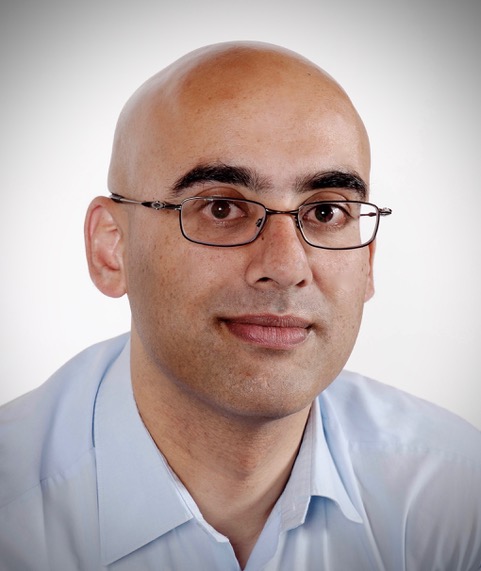
Marwan Fayed joined the University of St Andrews in 2018. He received his MA from Boston University and his PhD from the University of Ottawa, in 2003 and 2009 respectively, and in between worked at Microsoft as a member of the Core Reliability Group. In 2009 he joined the University of Stirling, UK as Scottish Informatics and Computer Science Alliance (SICSA) Lecturer, alongside an appointment to ‘Theme Leader’ for networking research in Scotland, 2014-2016. His current research interests lie in wireless algorithms, as well as general network, transport, and measurement in next generation edge networks. He is a co-founder of HUBS C.i.C., an ISP focussed on rural communities, recipient of an IEEE best paper award, and a Senior Member of both the IEEE and ACM.

Event details

  • When: 17th April 2018 14:00 - 15:00
  • Where: Cole 1.33a
  • Series: School Seminar Series
  • Format: Seminar

Computer Science student launches UK-wide app: Shrowze.


“The Human Personal Assistant you summon by text”

Computer Science student Nnamdi Ekwe-Ekwe launches a UK-wide app today, that frees up your time to do what you want to do rather than what you have to do. Shrowze is an app that provides everyone with their own human personal assistant to help them with whatever they need to do. It is the Human Personal Assistant you summon by text.

Nnamdi a PhD student in the School, built Shrowze in response to how long he saw it took people (himself included) to complete tasks that should be simple and straightforward (such as finding accommodation, booking a flight, organising and booking a meal, getting a plumber, etc.)

Nnamdi notes,

“As a full-time student I’ve always wanted to have more time for myself and concentrate on the truly important things, while not neglecting the numerous commitments I have every day – a problem shared by millions the world over. I just remember spending lots of time on routine everyday things that needed doing, when instead I could have been spending my time more usefully.”

With Shrowze, whatever it is you need doing, whatever it is you need getting, from wherever in the world, their team of human personal assistants can help – all you have to do is send a text. Shrowze has been trialed over the past 6 months with the general public and with students, receiving great feedback.

“Hi, I’m looking for accommodation for next year. This is my budget, and it’s going to be 4 of us sharing. Can you give us some potential places and book us viewings?”

“Hi, can you find me cheap flights to Barcelona for next week? And accommodation, and also give me a list of things to do there?”

“Hi, can you book me the best but cheapest taxi to the station? Three of us are going, we have two pieces of luggage!”


Shrowze is now live for all users across the country. For the next two weeks, anybody who signs up with Shrowze, will get 1 hour free time to have access to their own human personal assistant. Additionally, all students get a special 50% discount for as long as they are a student to use Shrowze.


Website – https://www.shrowze.co.uk/
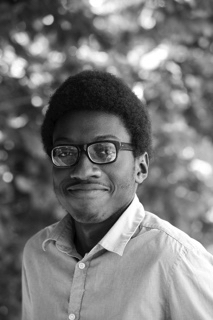
Nnamdi Ekwe-Ekwe completed his undergraduate degree at the University of Leicester before studying for his Masters in Advanced Computer Science at the University of St Andrews and is currently a PhD student with a focus on Cloud Computing.

Text and images courtesy of Darcy Roberts, Communications Team, Shrowze and Nnamdi.

DLS: Functional Foundations for Operating Systems

Biography: Dr. Anil Madhavapeddy is a University Lecturer at the Cambridge Computer Laboratory, and a Fellow of Pembroke College where he is Director of Studies for Computer Science. He has worked in industry (NetApp, Citrix, Intel), academia (Cambridge, Imperial, UCLA) and startups (XenSource, Unikernel Systems, Docker) over the past two decades. At Cambridge, he directs the OCaml Labs research group which delves into the intersection of functional programming and systems, and is a maintainer on many open source projects such as OpenBSD, OCaml, Xen and Docker.

Timetable
9:30: Introduction by Professor Saleem Bhatti
9:35: Lecture 1
10:35: Break with tea and coffee
11:15: Lecture 2
12:15: Lunch (not provided)
14:00: Lecture 3
15:00: Close by Professor Simon Dobson

Lecture 1: Rebuilding Operating Systems with Functional Principles
The software stacks that we deploy across computing devices in the world are based on shaky foundations. Millions of lines of C code crammed into monolithic operating system kernels, mixed with layers of scheduling logic, wrapped in a hypervisor, and served with a dose of nominal security checking on the side. In this talk, I will describe an alternative approach to constructing reliable, specialised systems with a familiar developer experience. We will use modular functional programming to build several services such as a secure web server that have no reliance on conventional operating systems, and explain how to express their logic in a high level, functional fashion. By the end of it, everyone in the audience should be able to build their own so-called unikernels!

Lecture 2: The First Billion Real Deployments of Unikernels
Unikernels offer a path to a more sane basis for driving applications on hardware, but will they ever be adopted for real? For the past fifteen years, an intrepid group of adventurers have been developing the MirageOS application stack in the OCaml programming language. Along the way, it has been deployed in many unusual industrial situations that I will describe in this talk, starting with the Docker container stack, then moving onto the Xen hypervisor that drives billions of servers worldwide. I will explain the challenges of using functional programming in industry, but also the rewards of seeing successful deployments quietly working in mission-critical areas of systems software.

Lecture 3: Programming the Next Trillion Embedded Devices
The unikernel approach of compiling highly specialised applications from high-level source code is perfectly suited to programming the trillions of embedded devices that are making their way around the world. However, this raises new challenges from a programming language perspective: how can we run on a spectrum of devices from the very tiny (with just kilobytes of RAM) to specialised hardware? I will describe the new frontier of functional metaprogramming (programs which generate more programs) that we are using to compile a single application to many heterogenous devices, and a Git-like model to coordinate across thousands of nodes. I will conclude with by motivating the need for a next-generation operating system to power new exciting applications such as augmented and virtual reality in our situated environments, and remove the need for constant centralised coordination via the Internet.

Event details

  • When: 13th February 2018 09:30 - 15:15
  • Where: Byre Theatre
  • Series: Distinguished Lectures Series, Systems Seminars Series
  • Format: Distinguished lecture